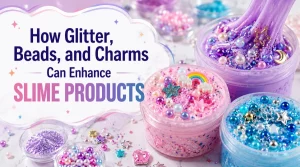
How Glitter, Beads, and Charms Can Enhance Slime Products
Learn how glitter, beads, and charms enhance slime products through visual appeal, tactile variety, themed play, and better product differentiation.
#1 Toys Manufacturer in China. WhatsApp: +86 139-6690-0919. Email: [email protected]

#1 Toys Manufacturer in China. WhatsApp: +86 139-6690-0919. Email: [email protected]

The best slime packaging depends on the product formula, quantity, target price, consumer usage, retail channel, and shipping requirements. For most private label slime products, jars and tubs are strong choices for reusable play, while cups work well for portion-controlled products, multi-pack sets, and lower-cost formats. Custom containers are most suitable when packaging itself is part of the product’s differentiation.
For toy brands, wholesalers, and retailers, packaging should therefore be selected as part of the product-development process—not added after the slime formula has already been finalized.
A practical way to select slime packaging is to evaluate six factors in order:
If cost and shipping efficiency are the main priorities, start with standard cups or simple tubs. If reusability and premium presentation are more important, consider higher-quality jars or customized containers.
Slime is a soft, flexible, and sometimes highly viscous sensory material. Its packaging therefore needs to do more than simply hold the product.
A suitable container should help:
For private label slime, the container also becomes part of the brand experience. Shape, size, lid design, transparency, decoration, and labeling can influence how the product is positioned in the market.
Jars are one of the most versatile packaging formats for slime. They are particularly suitable for products intended to be opened, played with, and stored repeatedly.
Choose jars when the product is designed for repeated use and you want packaging that consumers can easily close and store after play.
Jars are especially useful for:
However, rigid jars generally require more material and shipping space than flexible packaging. If logistics cost is highly sensitive, a smaller or lighter container may be more appropriate.
Tubs are a common choice for slime because they offer a useful balance between functionality, cost, and retail presentation.
Compared with some smaller cups, tubs can provide a wider opening, making it easier for children to remove and manipulate the slime.
If you need a practical container for a mainstream slime product without significantly increasing packaging cost, a standard tub is often one of the strongest starting points.
Tubs can also work well for multi-color collections when each color is packed separately or when several tubs are combined into a retail set.
Cups are often used for smaller slime quantities and value-oriented product formats.
Their main advantage is packaging efficiency. Smaller cups can make it easier to create multi-pack sets containing several colors, textures, or effects.
If the product’s selling point is variety rather than a large quantity of one slime, cups can be more efficient than larger jars or tubs.
However, small containers also mean more individual components per retail set. This can increase assembly, labeling, and packaging complexity.
Custom containers can help a slime product stand out through a distinctive shape, color, structure, or opening mechanism.
However, custom packaging should not be selected simply because it looks different.
A custom container is most commercially justified when the packaging contributes to product differentiation, brand recognition, usability, or a specific retail concept.
For startups testing a new slime concept, standard packaging is often more practical.
It can reduce development time, tooling costs, minimum order requirements, and packaging complexity.
Decision rule: Validate product-market fit with standard packaging first unless the container itself is essential to the product concept.
| Packaging Type | Best For | Main Advantage | Potential Limitation |
|---|---|---|---|
| Jar | Reusable and premium slime | Good usability and presentation | Higher packaging and shipping volume |
| Tub | Mass-market slime | Good balance of cost and usability | Less distinctive than custom packaging |
| Cup | Mini packs and multi-color sets | Efficient for small portions | Less suitable for large quantities |
| Custom Container | Differentiated or premium products | Strong visual and brand differentiation | Higher tooling and development requirements |
Choosing a container based only on its external dimensions can create problems. The internal capacity should be evaluated together with the slime’s actual volume, texture, filling process, and required headspace.
A suitable container should:
Do not select a container simply because it is labeled as a certain capacity. Test the actual slime formula in the actual container before finalizing the specification.
The lid is one of the most important components of a slime container.
A good lid should remain securely closed during transportation while still being practical for the intended user.
Key factors include:
For products designed for repeated play, resealing becomes particularly important.
If consumers are expected to store slime after opening, prioritize reliable resealing over purely decorative lid designs.
Slime packaging may experience pressure, vibration, stacking, temperature changes, and repeated handling during transportation.
This is especially important for products exported from China to North America and Europe.
Packaging evaluation should consider:
For international distribution, packaging should be tested under realistic transport conditions rather than evaluated only on the factory production line.
Transparent containers allow consumers to see the slime color, texture, glitter, beads, charms, or other visual effects. This can be useful when product appearance is a major part of the sales proposition.
Opaque containers provide more control over the visual presentation and can create more opportunities for printed graphics, labels, or themed designs.
The choice should depend on what sells the product.
If the slime itself is visually distinctive, transparent packaging can help showcase the product. If the brand concept depends more heavily on graphics and storytelling, opaque packaging may provide greater design flexibility.
Not every container is automatically suitable for every slime formula.
During product development, manufacturers should evaluate the interaction between the slime and the packaging material, particularly for products with special additives, effects, or unusual textures.
Compatibility evaluation can include:
The correct packaging specification should be confirmed with the actual slime formula, not selected independently from the product.
A container with a lower unit price is not always the lowest-cost packaging solution.
Total packaging cost may include:
For example, a larger rigid container may have a reasonable unit price but consume significantly more carton space than a compact cup.
For export-oriented slime products, evaluate packaging cost together with shipping volume and assembly efficiency.
Different market positions may require different packaging decisions.
Prioritize cost efficiency, reliable closure, simple decoration, efficient carton packing, and consistent production.
Recommended starting point: Standard cups or tubs.
Balance usability, visual presentation, packaging quality, and retail differentiation.
Recommended starting point: Higher-quality tubs or jars with customized labels and decoration.
Packaging can become a stronger part of the product proposition.
Recommended starting point: Well-designed jars or custom containers combined with premium retail packaging.
Packaging efficiency and organization become more important than large container volume.
Recommended starting point: Small cups or individually packaged portions inside a retail box.
For private label slime, a structured packaging-development process can reduce unnecessary revisions and production risks.
The most efficient approach is to finalize the packaging together with the formula, filling process, and retail configuration rather than treating packaging as a separate late-stage task.
Lower packaging cost can be attractive, but poor closure performance or weak material can create higher costs through leakage, damage, or customer complaints.
Oversized containers can increase packaging material usage and shipping volume without adding meaningful product value.
The container itself may be suitable while the lid creates the actual packaging problem. Closure performance should always be tested as a complete system.
A visually attractive container may not be compatible with the slime’s texture, viscosity, or additives.
Custom molds can increase tooling costs and minimum order requirements. They are most useful when they create a measurable product or branding advantage.
Retail packaging may look excellent individually but perform poorly when packed into master cartons. Carton dimensions, stacking, and protection should be considered during development.
Before approving a slime packaging solution, ask:
There is no single best slime container for every product. The right choice depends on what the slime needs to achieve in the market.
Choose jars when reusability and presentation are priorities. Choose tubs when you need a practical balance of cost and usability. Choose cups for small portions, multi-color sets, and efficient value formats. Choose custom containers when packaging itself creates meaningful product differentiation.
For OEM/ODM slime development, the strongest approach is to evaluate formula, container, closure, filling process, retail packaging, transportation, cost, and consumer usage as one system.
For children’s sensory toy products, applicable safety and regulatory requirements such as ASTM F963, EN71, and CPSIA should also be considered during product and packaging development.
Jars and tubs are generally suitable for reusable slime products, while cups work well for small portions and multi-pack sets. Custom containers are appropriate when packaging is an important part of product differentiation.
Both can work well. Jars may be preferable for premium or reusable products, while tubs often provide a practical balance between cost, usability, and retail presentation.
Yes. Cups are particularly useful for mini slime, multi-color sets, trial-size products, and value-oriented retail formats.
Slime packaging should provide a secure closure appropriate for the specific formula and intended storage conditions. The actual sealing performance should be validated during product development.
It can be worthwhile when the container provides meaningful differentiation, improves usability, supports premium positioning, or is essential to the product concept. For startups testing demand, standard packaging is often more cost-effective.
Match the container to the actual slime quantity, product volume, filling process, required headspace, and consumer usage. Test the actual formula in the selected container before final approval.
Consider packaging quality, formula compatibility, sealing performance, customization capabilities, MOQ, tooling requirements, carton efficiency, transportation testing, and applicable children's product requirements.
More Related...
Learn how glitter, beads, and charms enhance slime products through visual appeal, tactile variety, themed play, and better product differentiation.
Learn the key steps behind a successful slime launch, from product development and sampling to safety compliance, packaging, and production.
Explore what makes slime safe for children and learn simple ways to support fun, responsible, and healthy sensory play at home or school.
Explore the key traits behind best-selling slime products on Amazon, from texture and safety to developmental value and consumer demand.

Our team will answer your inquiries within 48 hours.
Copyright © 2026 GuangDong AKIA Technology Co,. Ltd. All Rights Reserved