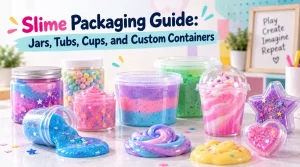
Slime Packaging Guide: Jars, Tubs, Cups, and Custom Containers
Compare slime jars, tubs, cups, and custom containers to find the right packaging for your product, budget, target market, and shipping needs.
#1 Toys Manufacturer in China. WhatsApp: +86 139-6690-0919. Email: [email protected]

#1 Toys Manufacturer in China. WhatsApp: +86 139-6690-0919. Email: [email protected]

| Item | Project Approach |
|---|---|
| Brand type | Small children's sensory toy brand |
| Product | Private label slime |
| Initial range | 4 core SKUs |
| Target users | Children and families |
| Main sales channels | E-commerce and specialty retail |
| Key priorities | Texture, visual differentiation, packaging, safety and repeatability |
| Development model | Sample → test → refine → pilot → scale |
| Safety requirements | ASTM F963, EN71 and CPSIA, depending on target market |
| Main lesson | Validate a small number of strong SKUs before expanding the range |
| SKU | Product Direction | Primary Differentiator |
|---|---|---|
| 01 | Clear slime | Transparency and color |
| 02 | Cloud-style slime | Soft, fluffy texture |
| 03 | Glitter slime | Visual inclusions |
| 04 | Crunchy slime | Tactile texture |
This created enough variety to test customer preferences without making the first order unnecessarily complex.
The four products also had a clear role within the collection.
The clear slime provided a simple entry product. The cloud-style slime focused on texture. Glitter created visual differentiation, while the crunchy version provided a more pronounced tactile experience.
For a small brand, a launch assortment should ideally test different product attributes rather than minor variations of the same attribute.
Launching four colors of essentially identical slime primarily tests color preference.
Launching four meaningfully different sensory experiences can reveal much more about what customers actually value.
That information becomes useful when planning the second production run.
Once the product directions were established, sample development began.
The manufacturer adjusted variables including:
The goal of sampling was not simply to produce something that looked attractive.
The samples needed to answer three separate questions.
The slime should behave consistently with its product positioning.
If a product is marketed around stretch, softness or crunch, that characteristic needs to be obvious when the package is opened.
A successful handmade sample is not enough.
The formulation needs to be translated into repeatable production specifications so that future batches remain reasonably consistent in texture, appearance and fill weight.
Slime and packaging should be evaluated together.
Container dimensions, closure performance, filling method, labeling area and shipping configuration can all affect the final product.
Decision: approve the product and container combination before investing heavily in customized outer packaging.
This reduced the risk of designing packaging around a product format that later needed to change.
For children’s slime, safety should not be added at the end of product development.
It should influence material selection and formulation from the beginning.
Depending on the destination market and product classification, applicable requirements may include standards such as:
Testing requirements can vary according to the product, materials, age grading and destination market. Brands should therefore establish the intended market before approving the final formulation and packaging.
Consider two development paths.
Path A: formulate first, complete packaging, begin production planning and then investigate testing.
Path B: identify the target market, develop with appropriate material requirements, finalize the product and then test the production-representative version.
Path B reduces the possibility that a material or component must be changed late in development.
For our sensory toy manufacturing projects in Foshan, China, products such as slime, playdough, air dry clay and kinetic sand can be developed to meet applicable ASTM F963, EN71 and CPSIA requirements according to the target market and project specifications.
The important purchasing question is therefore not simply:
“Does the factory have certificates?”
A more useful question is:
“Can the product I am ordering be produced and tested against the requirements applicable to my target market?”
The brand initially considered highly customized packaging for every SKU.
Instead, the first launch used a more controlled packaging architecture: the products shared a common brand system while colors, names and graphics differentiated individual variants.
This approach had several advantages.
It made the collection visually consistent, simplified packaging management and allowed new variants to be introduced without redesigning the entire range.
Retail environment: A product sold primarily through physical stores may need stronger front-of-pack communication and shelf presence.
E-commerce: Products sold online need packaging that photographs clearly and survives fulfillment.
Order volume: Highly customized packaging can become more economical as volume increases, but may create unnecessary cost or inventory risk during market validation.
For a first slime launch, packaging should therefore be judged by more than appearance.
It should also be evaluated for:
brand recognition + product protection + labeling space + production efficiency + shipping practicality.
After the formulation and packaging direction were approved, the next step was a controlled first production run.
This stage tested more than the slime itself.
It tested the complete commercial product:
formula → filling → container → label → packing → carton → shipment
This distinction matters.
A product can perform well during laboratory sampling but still encounter issues during filling, sealing, storage or transportation.
The first run therefore provided an opportunity to check:
Only after the product system was stable was larger-scale expansion considered.
The launch produced a useful result: customers did not value every SKU equally.
The more visually and texturally distinctive products generated stronger demand than some of the simpler variants.
Instead of immediately creating another ten products, the brand used those results to guide development.
The next collection could therefore be built around the characteristics that customers had already validated.
For example, if crunchy slime performs better than a standard clear slime, the next development cycle might test:
This is a lower-risk expansion strategy than repeatedly adding unrelated products.
A practical slime product-development cycle is:
Launch → measure → identify winning attributes → create controlled variations → measure again.
The brand is not simply asking, “What new slime can we make?”
It is asking, “Which product attribute has already demonstrated demand, and how can we extend it?”
That is a more useful question for building a repeatable product line.
The project did not depend on one unusual formula or packaging trick.
Its strongest decisions were structural.
| Decision | Why It Mattered |
|---|---|
| Started with a focused assortment | Reduced inventory and development risk |
| Tested different sensory experiences | Generated more useful customer data |
| Sampled before mass production | Allowed formulation adjustments |
| Considered compliance early | Reduced late-stage redesign risk |
| Tested product and packaging together | Improved commercialization readiness |
| Used a pilot production stage | Identified manufacturing issues before scaling |
| Expanded according to sales data | Put development budget behind validated demand |
The broader lesson is simple:
A best-selling slime line is usually built through product validation and iteration, not by maximizing the number of SKUs at launch.
When evaluating a private label or custom slime supplier, price is only one part of the decision.
A useful supplier evaluation should cover the following questions:
| Question | What It Helps Determine |
|---|---|
| Can you customize slime texture? | Product differentiation capability |
| Can you provide samples before production? | Development and validation process |
| What packaging options are available? | Branding and commercialization capability |
| What is the MOQ for each customization level? | Launch feasibility |
| How do you control batch consistency? | Manufacturing repeatability |
| Which toy safety standards can the product be tested against? | Market compliance planning |
| Can you support repeat orders using the approved specification? | Scalability |
| Can packaging and labeling be customized? | Private label readiness |
| What changes when order volume increases? | Long-term cost and production planning |
A supplier that gives clear answers to these questions is more useful to a growing brand than one that provides only a product catalog and unit price.
There is no universal development time because complexity varies by formulation, packaging and testing requirements.
A typical project can be divided into five stages:
Simple private label projects using existing formulations and packaging can generally move faster than projects requiring a new formulation, custom molds or complex packaging.
For this reason, brands should ask manufacturers for a project-specific timeline after the specification is defined, rather than relying on a generic production lead time.
For many first-time brands, the right choice depends on how much differentiation the market actually requires.
Private label slime is generally more suitable when speed, lower development complexity and market testing are the priorities.
Custom slime development becomes more attractive when texture, sensory characteristics, appearance or packaging are central to the brand’s competitive positioning.
A practical decision rule is:
Start with the lowest level of customization that can still create a meaningful reason for customers to choose your product.
More customization is not automatically better. It should solve a specific product or branding problem.
A small brand does not need a large catalog to build a commercially viable slime collection.
It needs a controlled development process.
The strongest approach is to:
The core principle is validation before expansion.
That applies not only to slime, but also to other sensory toy categories such as playdough, air dry clay and kinetic sand.
If you are developing a children’s slime brand, the most useful starting point is a clear product brief rather than a request for a generic catalog.
Our sensory toy manufacturing team in Foshan, China supports private label and custom development for slime, air dry clay, playdough and kinetic sand, with products developed for applicable ASTM F963, EN71 and CPSIA requirements.
To evaluate a new slime project, prepare these six pieces of information:
target market, desired slime texture, number of SKUs, fill size, packaging concept and estimated order quantity.
With those details, a manufacturer can determine which formulation, customization level, sampling process and production route are appropriate for the project.
Have a slime concept already? Send us your product requirements to discuss formulation, samples, packaging and production options.
More Related...
Compare slime jars, tubs, cups, and custom containers to find the right packaging for your product, budget, target market, and shipping needs.
Learn how glitter, beads, and charms enhance slime products through visual appeal, tactile variety, themed play, and better product differentiation.
Explore what makes slime safe for children and learn simple ways to support fun, responsible, and healthy sensory play at home or school.
Explore the key traits behind best-selling slime products on Amazon, from texture and safety to developmental value and consumer demand.

Our team will answer your inquiries within 48 hours.
Copyright © 2026 GuangDong AKIA Technology Co,. Ltd. All Rights Reserved