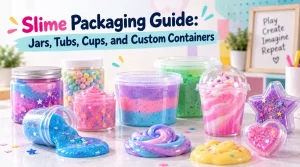
Slime Packaging Guide: Jars, Tubs, Cups, and Custom Containers
Compare slime jars, tubs, cups, and custom containers to find the right packaging for your product, budget, target market, and shipping needs.
#1 Toys Manufacturer in China. WhatsApp: +86 139-6690-0919. Email: [email protected]

#1 Toys Manufacturer in China. WhatsApp: +86 139-6690-0919. Email: [email protected]

When sourcing slime toys for the United States or European Union, buyers should not treat “tested,” “non-toxic,” or “compliant” as complete answers. The applicable requirements depend on the exact product, intended age, formulation, accessories, packaging, warnings, destination market, and the role your company plays in the supply chain.
This guide gives brands, importers, distributors, and sourcing teams a practical framework for discussing slime toy compliance with suppliers and testing partners. It is not a substitute for a product-specific regulatory assessment.
Before discussing standards, freeze enough of the product specification to identify what must be assessed. A report for one slime formula or kit does not automatically cover every variation.
Document:
If the color, fragrance, inclusion, container, accessory, or supplier changes, ask whether the existing assessment still covers the final product.
The U.S. Consumer Product Safety Commission states that ASTM F963 is incorporated as a mandatory consumer product safety standard for children’s toys through 16 CFR part 1250. The current CPSC guidance identifies ASTM F963-23 as the mandatory version for toys manufactured after April 20, 2024. Buyers should check the latest CPSC Toy Safety Business Guidance at the time of production.
For toys designed or intended primarily for children 12 years of age or younger, the CPSC explains that applicable children’s product rules generally require third-party testing by a CPSC-accepted laboratory and certification in a Children’s Product Certificate, or CPC. The domestic manufacturer or U.S. importer is responsible for identifying the requirements that apply to the product and issuing the certificate based on compliant test results.
Depending on the product, review may extend beyond the general toy standard. Relevant questions can include:
The CPSC’s toy safety FAQ and ASTM F963 requirements chart can help a buyer understand the assessment process. A qualified laboratory or compliance professional should determine the final test plan for the exact item.
Before approving production, ask the supplier and testing laboratory:
Do not rely only on a report cover page. Match the sample description, photographs, model numbers, materials, dates, and test scope to the item you intend to import.
As of this article’s preparation in August 2026, the EU’s existing Toy Safety Directive 2009/48/EC remains central to toys placed on the EU market during the transition to Regulation (EU) 2025/2509. EUR-Lex states that the new regulation will replace the directive from 1 August 2030, with certain provisions applying earlier. Buyers should plan current projects under the applicable rules today while also preparing product-data and documentation systems for the coming framework.
Under the current EU process, manufacturers must carry out a safety assessment, use the applicable conformity-assessment procedure, prepare technical documentation, draw up an EC Declaration of Conformity, provide required traceability and safety information, and affix the CE marking when compliance has been demonstrated. Importers have their own obligations to verify that the manufacturer has completed the required steps and that documentation and markings are available.
The European Commission’s guide to placing toys on the EU market summarizes the responsibilities of manufacturers, importers, and distributors. The legal text of Directive 2009/48/EC remains the authoritative source for the directive framework.
Regulation (EU) 2025/2509 was adopted in November 2025. According to the current EUR-Lex summary, it generally applies from 1 August 2030 and introduces an updated toy-safety framework that includes a digital product passport and strengthened chemical controls.
For a sourcing team, this creates two practical tasks:
Do not add a digital product passport symbol or claim future compliance simply because a supplier has seen the new regulation. Build a transition plan based on the product’s production and market dates and current implementing guidance.
Slime is a chemical mixture or material intended to be handled during play, so formulation control deserves particular attention. The test plan should be based on the actual ingredients, foreseeable exposure, intended age, and destination market—not on the product name alone.
Ask the supplier for controlled formulation and material information suitable for the compliance process. Confirm whether fragrances, pigments, preservatives, decorative inclusions, containers, or accessories change the risk assessment or test scope. If the formulation changes after testing, document the change and ask a qualified reviewer whether reassessment is necessary.
Avoid broad marketing statements such as “chemical-free,” “100% safe,” or “approved for every market.” They are difficult to support and may mislead buyers or consumers.
When reviewing a supplier’s test report or certificate, confirm:
A valid report for a similar item is useful background, but it is not automatically evidence for your final SKU.
Compliance is easier to manage when it is part of product development rather than a final inspection step.
Use stage gates:
A capable supplier discussion should connect product development with testing, documentation, packaging, and change control. When reviewing wholesale slime product options, provide the intended market and age group at the beginning of the project. Ask which product details must be fixed before testing and what evidence can be supplied for the exact configuration.
You can also review Huilian Toy’s certificates and test-report information and broader toy safety resources. The relevance of any document must still be confirmed against the final product and destination market.
Before approving a slime toy order, confirm that you have:
The safest procurement decision is not based on the largest stack of certificates. It is based on a clear chain of evidence connecting the exact product, applicable requirements, approved sample, controlled production, and final shipment.
This article provides general sourcing information and is not legal, testing, or regulatory advice. Rules and guidance change. Confirm the requirements for your exact product, economic-operator role, production date, and destination market with current official sources and qualified professionals.
Safety standards are crucial to protect children from potential harm caused by toxic ingredients or unsafe manufacturing practices. These regulations ensure that slime toys are free from harmful chemicals like lead or phthalates and that they meet the necessary durability and safety guidelines for children’s use.
Manufacturers must perform thorough testing on slime toys, including chemical and toxicity tests, before they are released. They also must follow national or international safety standards like ASTM in the U.S. and EN71 in Europe. Certification from third-party labs and regulatory bodies helps confirm compliance.
Yes, both North American and European standards have strict regulations regarding the ingredients in slime. Harmful substances such as lead, phthalates, and certain preservatives must be eliminated. Manufacturers are required to submit toxicology reports and ingredient lists to ensure their products are safe.
Proper labeling is a critical part of slime toy safety. Labels should include age recommendations, safety warnings, and ingredient information. Clear instructions on safe use, handling, and storage also help ensure that consumers understand the risks and how to use the toy safely.
Retailers play an important role by only stocking slime toys that meet safety standards. They can verify compliance through certification documents and by working with trusted suppliers. Additionally, educating customers on safe use and proper handling of slime toys can further reduce risks.
More Related...
Compare slime jars, tubs, cups, and custom containers to find the right packaging for your product, budget, target market, and shipping needs.
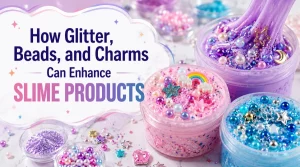
Learn how glitter, beads, and charms enhance slime products through visual appeal, tactile variety, themed play, and better product differentiation.
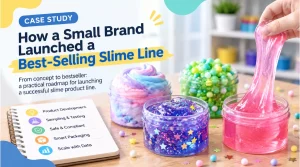
Learn the key steps behind a successful slime launch, from product development and sampling to safety compliance, packaging, and production.
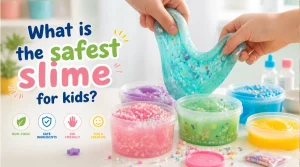
Explore what makes slime safe for children and learn simple ways to support fun, responsible, and healthy sensory play at home or school.

Our team will answer your inquiries within 48 hours.
Copyright © 2026 GuangDong AKIA Technology Co,. Ltd. All Rights Reserved