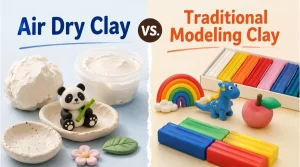
Air Dry Clay vs. Traditional Modeling Clay
Choosing between air dry clay and modeling clay depends on the activity goal. Explore their features, uses, and selection tips in this complete guide.
#1 Toys Manufacturer in China. WhatsApp: +86 139-6690-0919. Email: [email protected]

#1 Toys Manufacturer in China. WhatsApp: +86 139-6690-0919. Email: [email protected]

Packaging directly affects the shelf life of air dry clay because it controls moisture loss, protects the clay from air exposure, and reduces the impact of temperature, humidity, contamination, and physical damage during storage and transportation. For toy brands, wholesalers, and retailers, choosing the right packaging is therefore part of product development—not simply a branding decision.
The most important principle is simple: the more sensitive the clay formula is to moisture loss, the more important the package’s moisture barrier and seal quality become. A well-designed package can help maintain the clay’s original softness, workability, color, and appearance throughout its intended storage and distribution period.
Air dry clay is designed to harden when exposed to air. This makes moisture management one of the most important packaging considerations.
During normal storage, unwanted moisture loss can gradually change the product before it reaches the consumer. If the package does not provide sufficient protection, the clay may become:
For this reason, shelf life should be evaluated together with packaging performance rather than treating the formula and package as completely separate components.
The moisture barrier is usually the most important packaging factor for air dry clay.
Because the product needs to retain its moisture during storage, packaging materials should limit moisture transfer between the clay and the surrounding environment.
Decision logic: If your product will be stored for long periods, shipped across different climates, or sold through multiple distribution channels, prioritize packaging with reliable moisture-barrier performance over packaging chosen mainly for appearance.
A package can have a suitable material but still perform poorly if the seal is weak or inconsistent.
Small gaps, incomplete seals, damaged closures, or poorly fitted lids can increase air exchange and accelerate moisture loss.
For private label products, manufacturers should evaluate the complete packaging system, including:
Key point: Packaging material and sealing performance must be evaluated together. A high-quality material cannot compensate for an unreliable seal.
The relationship between the amount of clay and the internal space of the package can also affect product performance.
Excessive empty space may increase the amount of air surrounding the product, while an oversized package can also increase packaging costs and shipping volume.
For this reason, the package should be appropriately matched to the product weight and format.
Decision logic: Choose the smallest practical package size that provides sufficient product protection, usability, labeling space, and retail presentation.
Different air dry clay formats require different closure solutions.
For example, individual clay portions may use sealed bags or pouches, while larger quantities may be packed in containers with fitted lids or additional inner seals.
A closure should achieve two objectives:
This second point is particularly important for children’s products. If the consumer cannot close the package properly after use, the product may dry out faster after the first opening.
When evaluating shelf life, it is useful to separate primary packaging from secondary and transport packaging.
Primary packaging directly contacts or encloses the clay and therefore has the most direct effect on moisture retention.
Common primary packaging formats include:
Secondary packaging, such as cartons and retail boxes, mainly provides structural protection, branding space, product organization, and retail presentation. It can support overall product protection, but it normally cannot replace an effective primary moisture barrier.
For air dry clay, primary packaging should be the first packaging layer evaluated when the goal is to protect shelf life.
There is no single packaging format that is best for every air dry clay product. The right choice depends on product quantity, positioning, target price, distribution conditions, and consumer usage.
Flexible packaging is often suitable for individual clay portions, refill packs, multi-color sets, and products where low packaging weight and efficient shipping are important.
Advantages:
Potential limitations:
Containers are often preferred when brands want stronger physical protection, easier storage, or a more reusable package.
Advantages:
Potential limitations:
Practical decision: Choose flexible packaging when shipping efficiency and portion-based formats are priorities. Consider containers when reusability, physical protection, and repeated opening and closing are more important.
For air dry clay sold internationally, the product may experience significant changes in temperature, humidity, handling conditions, and storage duration before reaching the final consumer.
A typical B2B supply chain may involve:
Factory → Export Warehouse → Ocean or Air Freight → Import Warehouse → Distribution Center → Retail Store → Consumer
Each stage creates additional opportunities for packaging damage or environmental exposure.
For products shipped from China to North America or Europe, packaging design should therefore consider the complete logistics process rather than only factory storage conditions.
Decision logic: The longer and more complex the supply chain, the more important package sealing, moisture barrier performance, structural protection, and transport testing become.
Packaging does not eliminate the effects of the surrounding environment. Storage conditions can still influence the performance of air dry clay.
High temperatures, high humidity, repeated temperature changes, and prolonged storage can all affect packaging and product behavior.
For this reason, shelf-life evaluation should consider both:
A package that performs well in controlled factory conditions may still require validation under realistic transportation and storage conditions.
Air dry clay can be developed in different formats, and each format may require a different packaging strategy.
| Product Format | Packaging Priority | Typical Consideration |
|---|---|---|
| Individual Color Portions | Moisture retention | Sealed bags or pouches |
| Multi-Color Sets | Individual portion protection | Separate sealed units inside a retail package |
| Larger Bulk Packs | Moisture protection and physical strength | Containers or heavy-duty sealed packaging |
| Refill Packs | Shipping efficiency | Flexible moisture-barrier packaging |
| Premium Gift Sets | Protection plus presentation | Primary sealed package combined with retail box |
It is important to distinguish between unopened shelf life and product performance after opening.
An unopened package may provide strong protection against moisture loss. Once opened, however, the product is exposed to air and the remaining clay may gradually change.
Packaging should therefore make proper storage easy for consumers.
Useful features may include:
For multi-color clay sets, individually sealed color portions can be particularly useful because unused colors remain protected while another color is being used.
Retail packaging has to balance protection with product visibility.
Transparent packaging can allow buyers to see the clay colors and quantity, while opaque packaging may provide greater protection from light and create more design flexibility.
The correct decision depends on the product and brand positioning.
If product visibility is a major selling point, use transparent elements where appropriate, but make sure the primary packaging still provides sufficient protection for the clay.
For children’s sensory products, the package should also provide enough space for required product information, warnings, age grading, instructions, and applicable compliance information.
A visually attractive package does not automatically provide adequate moisture protection.
Better approach: Evaluate barrier performance and sealing reliability before finalizing the visual design.
If the package cannot maintain a reliable seal, the product may lose moisture faster than expected.
Better approach: Test the complete package rather than evaluating only the packaging material itself.
Packaging designed only for factory storage may not be suitable for international logistics.
Better approach: Consider shipping duration, handling, stacking, temperature variation, and warehouse storage.
Large packages can increase air space, material usage, shipping volume, and overall cost without necessarily improving product protection.
Better approach: Match package dimensions closely to the actual product quantity and intended retail format.
A package may perform well before opening but provide little protection afterward.
Better approach: Consider how consumers will close and store the product after each use.
Before launching a private label air dry clay product, manufacturers and buyers should evaluate the complete product-package combination.
A practical development process can include:
The key principle is to validate the formula and packaging as one system. This approach reduces the risk of discovering shelf-life or packaging problems after mass production.
When selecting packaging for private label air dry clay, buyers can use the following decision sequence:
When working with an OEM/ODM manufacturer, buyers should not only ask about the clay formula. Packaging performance should also be included in the product-development discussion.
Useful questions include:
These questions help buyers evaluate whether a manufacturer can provide a complete product solution rather than simply supplying clay in standard packaging.
For air dry clay, packaging is not just a container—it is part of the product’s shelf-life strategy. The most important considerations are moisture-barrier performance, sealing reliability, package size, closure design, transportation conditions, and post-opening usability.
For B2B buyers developing private label air dry clay, the best packaging solution is not necessarily the cheapest or most visually attractive option. It is the one that provides the required product protection while meeting the target retail price, shipping requirements, consumer usage pattern, and brand positioning.
A reliable OEM/ODM development process should therefore evaluate formula + packaging + storage + transportation + consumer use as one complete system. For children’s sensory products, applicable safety and regulatory requirements such as ASTM F963, EN71, and CPSIA should also be considered as part of the overall product-development process.
Yes. Packaging can significantly influence shelf life by controlling moisture loss, air exposure, contamination, and physical damage during storage and transportation.
There is no universal best option. Sealed flexible packaging is often suitable for individual portions and refill packs, while rigid containers can be useful when reusability and physical protection are priorities.
Moisture loss is a major reason. Inadequate sealing, damaged packaging, prolonged storage, or unsuitable environmental conditions can contribute to premature drying.
Not necessarily. The container's material, lid fit, seal design, and overall closure performance all influence moisture retention.
Resealable packaging can be beneficial when consumers are expected to use the product multiple times. Its effectiveness depends on how well the closure limits air exchange after opening.
For multi-color sets, individual sealed portions can help protect unused colors after the package is opened. This can improve usability and reduce unnecessary exposure to air.
Yes. Packaging should be evaluated together with the clay formula under relevant storage and transportation conditions before finalizing a mass-production solution.
More Related...
Choosing between air dry clay and modeling clay depends on the activity goal. Explore their features, uses, and selection tips in this complete guide.
Understand the science behind eco-friendly air dry clay, including material selection, production difficulties, and the future of sustainable toy materials.
Find out why parents and educators prefer DIY craft kits that encourage hands-on learning, independent creativity, and skill development.
Understand how toy ideas become finished products through OEM manufacturing, with key steps, decision points, and compliance requirements.

Our team will answer your inquiries within 48 hours.
Copyright © 2026 GuangDong AKIA Technology Co,. Ltd. All Rights Reserved