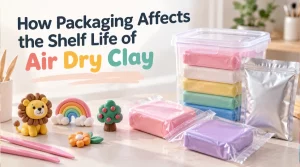
How Packaging Affects the Shelf Life of Air Dry Clay
Learn how packaging affects air dry clay shelf life, moisture retention, product quality, and shipping performance, with practical tips for toy brands.
#1 Toys Manufacturer in China. WhatsApp: +86 139-6690-0919. Email: [email protected]

#1 Toys Manufacturer in China. WhatsApp: +86 139-6690-0919. Email: [email protected]

The right air dry clay formula for kids’ craft kits depends on the target age group, intended craft projects, required drying time, finished-product strength, texture, color range, and packaging format. For toy brands and private-label buyers, the best formula is not necessarily the softest, cheapest, or fastest-drying option. It is the one that provides the right balance of workability, safety, durability, and cost for the intended use.
When developing an air dry clay kit, buyers should evaluate the clay as part of the complete product rather than as an isolated material. A formula that works well for simple children’s modeling activities may not perform equally well for detailed figurines, ornaments, educational craft projects, or gift sets containing multiple tools and accessories.
This guide explains how to compare air dry clay formulas, match material properties to different craft kit concepts, identify common formulation trade-offs, and evaluate OEM/ODM suppliers before placing a production order.
A suitable air dry clay formula should be easy to shape, maintain enough detail for the intended project, dry within an acceptable timeframe, and provide appropriate strength after drying. It should also meet the applicable product safety and regulatory requirements for its target market and intended age group.
For commercial craft kits, buyers should evaluate six main factors:
Decision rule: Start with the craft activity and target user, then select the formula. Do not select a formula based only on a sample’s initial softness or appearance.
Air dry clay is a broad product category. Different formulations can use different material systems and may have substantially different handling and drying characteristics. Buyers should first establish which type of clay is appropriate for the intended craft kit.
| Clay Type or Product Direction | Typical Characteristics | Potential Applications | Key Evaluation Point |
|---|---|---|---|
| Soft, lightweight air dry clay | Designed for easy manipulation and lightweight finished creations | Simple figures, decorations, themed craft kits | Check shape retention, surface finish, and finished strength. |
| Fine-textured air dry clay | Designed to support smoother surfaces and more controlled shaping | Miniature models, decorative objects, detailed craft projects | Check detail retention, surface cracking, and drying consistency. |
| Firm modeling-oriented air dry clay | Provides more resistance during shaping and may help retain certain forms | Structured models, thicker shapes, selected educational activities | Check whether the firmness is appropriate for the target age group. |
| Traditional mineral-based air dry clay | Often has a denser feel and different drying and finishing behavior from lightweight craft clays | Selected modeling, sculpting, and classroom craft applications | Check drying shrinkage, cracking, weight, and handling requirements. |
These are broad product directions, not standardized formula classifications. Actual performance depends on the materials, additives, manufacturing process, and product specifications used by the supplier.
Terms such as “lightweight,” “ultra-soft,” and “fine-textured” are not sufficient evidence of performance. Buyers should request representative samples and evaluate them against defined acceptance criteria.
The final choice should be based on sample testing, the product’s intended use, and the buyer’s commercial requirements.
Softness affects how easily children can manipulate air dry clay, but softer clay is not automatically better. A formula that is too firm may be difficult to shape, while a formula that is too soft may lose its shape or make detailed modeling more difficult.
The target age group should therefore guide the balance between softness, firmness, and shape retention.
| Target User or Activity | Preferred Performance | Potential Problem to Check |
|---|---|---|
| Young children, subject to the product’s approved age grading | Easy-to-manipulate clay that requires limited force | Excessive firmness, small detachable accessories, and age-related safety concerns. |
| School-age children making basic shapes | Balanced softness with adequate shape retention | Clay that sticks excessively to tools or collapses after shaping. |
| Older children creating detailed models | Controlled workability and the ability to preserve fine features | Overly soft clay that loses detail or overly firm clay that limits manipulation. |
| Guided classroom craft projects | Predictable handling and consistent performance across portions | Significant differences between colors, batches, or storage conditions. |
These are product-development guidelines rather than universal age-based specifications. Buyers must determine the intended age range through product design, applicable safety assessments, and market requirements.
Use the same quantity of clay for each sample and evaluate it under consistent conditions.
Decision rule: Choose the formula that meets your workability and shape-retention requirements consistently, not simply the formula that feels softest during the first few seconds of testing.
Drying performance is one of the most important considerations when selecting air dry clay for children’s craft kits. The ideal drying profile depends on the thickness of the finished object, the intended activity, the expected handling conditions, and the time users are willing to wait before decorating or displaying their creations.
Fast drying is not always an advantage. If a formula dries too quickly for the intended activity, children may have less time to reshape their work. If it dries too slowly, thicker pieces may remain vulnerable to deformation or damage for longer.
Air dry clay generally dries through moisture loss, but the actual drying time depends on several factors:
For this reason, suppliers should not be compared using drying-time claims unless the test conditions and sample dimensions are comparable.
For each candidate formula, prepare samples with the same dimensions and shapes. Record the initial weight, drying environment, and observations at defined intervals.
Evaluate the samples for:
Surface dryness should not be treated as proof that the entire object has dried. Thick pieces may retain moisture internally even when the outer surface feels dry.
Decision rule: Select a formula based on an acceptable drying window and finished-product performance under defined test conditions. Avoid choosing solely by the shortest advertised drying time.
Once dried, clay creations may be handled, displayed, packed, or transported. A formula that is easy to shape but produces fragile finished pieces may not be appropriate for projects involving thin limbs, narrow edges, or protruding details.
Test representative shapes rather than relying only on solid blocks. Compare the frequency of cracking, deformation, and breakage under a consistent and documented handling method.
For craft kits designed around permanent decorative objects, finished strength and dimensional stability may deserve more weight than extreme softness. For temporary or simple modeling activities, workability may be the higher priority.
Texture affects the user experience and the types of projects a craft kit can support. The right formula should provide a suitable balance between smoothness, adhesion, flexibility during shaping, and surface quality after drying.
| Performance Factor | Why It Matters | What to Test |
|---|---|---|
| Smoothness | Influences the appearance of finished creations and the ease of making small details. | Roll thin sheets, smooth joints, and inspect the surface under consistent lighting. |
| Stickiness | Excessive stickiness can make shaping difficult and leave residue on tools or work surfaces. | Use the same tools and contact time to compare residue and ease of release. |
| Shape retention | Helps creations retain their intended form during assembly and early drying. | Make repeated shapes and measure or record deformation over time. |
| Joining performance | Influences whether separate clay components remain attached during shaping and drying. | Join standardized pieces using the recommended method and inspect the joints after drying. |
| Surface cracking | Can affect the appearance and structural quality of finished projects. | Compare samples of the same shape and thickness under the same drying conditions. |
Do not assume that a single texture characteristic determines overall quality. A highly smooth formula may be less suitable for a project that requires more resistance during shaping, while a very soft formula may need additional evaluation for fine details and dimensional stability.
Decision rule: Define the surface finish and handling requirements for the actual craft projects in your kit, then test each formula against those requirements.
Color is both a design decision and a product-performance consideration. Buyers should evaluate color range, consistency between batches, color transfer, and compatibility with any planned painting or decorating activities.
| Option | Potential Advantages | Best Fit | What to Check |
|---|---|---|---|
| Pre-colored clay | Ready-to-use colors, less need for separate coloring steps, and a coordinated kit appearance. | Multi-color craft kits, themed projects, and activities where color selection is part of the experience. | Color consistency, staining, color transfer, and consistency of handling across shades. |
| White or neutral clay | Provides a base for selected painting, decorating, or customization activities. | Craft kits focused on painting or surface decoration after drying. | Compatibility with the intended paints, surface preparation, drying requirements, and finished appearance. |
Pre-colored clay can simplify the activity design, but more colors may increase formulation, production, packaging, and quality-control complexity. White clay may offer flexibility for decoration, but it does not guarantee that every paint or coating will adhere properly.
Ask the supplier to provide samples of the proposed colors and, where possible, samples from different production batches. Compare the colors under consistent lighting and inspect the material before and after drying.
For multi-color kits, also check whether each color has similar workability and drying behavior. Pigments and other formulation differences may influence the final performance, so a successful test of one color should not automatically be treated as approval for the entire color range.
If the kit includes painting accessories, evaluate the complete process using the intended paint, brushes, and drying instructions.
The most effective formula selection starts with the product concept. Different craft kits create different demands on the clay, and the same material may not be optimal for every application.
| Craft Kit Concept | Recommended Performance Priorities | Potential Accessories | Key Development Test |
|---|---|---|---|
| Basic modeling kit | Easy shaping, balanced softness, and consistent handling. | Basic modeling tools, rollers, and shape cutters. | Check how easily users can make repeated simple shapes. |
| Miniature and figurine kit | Fine-detail retention, surface smoothness, and dimensional stability. | Detailing tools, texture tools, and molds. | Check small features, joints, and deformation during drying. |
| Painting and decoration kit | Suitable surface finish, drying performance, and compatibility with the selected decoration method. | Paints, brushes, decorating tools, and palettes. | Test the complete clay-drying-painting process. |
| Seasonal or themed craft kit | Coordinated colors, repeatable shapes, and suitable finished appearance. | Themed cutters, molds, and decorative components. | Check color consistency and performance across the full kit. |
| Educational classroom kit | Repeatable workability, manageable portions, and clear storage instructions. | Reusable modeling tools, activity cards, and project guides. | Run repeated-use trials and evaluate consistency across portions. |
These recommendations are starting points rather than fixed specifications. Final requirements should reflect the target age group, intended activity, retail price point, packaging, and buyer’s product brief.
Air dry clay can lose moisture during storage if the packaging does not provide adequate protection. A formula that performs well immediately after opening may not deliver the same experience if the product dries out before the customer uses it.
Packaging selection should therefore be evaluated alongside the formula, particularly for multi-color craft kits and products intended to remain on retail shelves for extended periods.
Buyers should request storage and shelf-life information supported by appropriate product testing rather than assuming that all air dry clay formulas have the same storage requirements.
Evaluate the selected clay in its intended retail packaging, not only in a laboratory sample container. Where practical, conduct storage trials under defined conditions and check for changes in softness, stickiness, odor, color, and ease of shaping.
Also inspect packaging after transport simulation or other appropriate distribution testing. The goal is to confirm that the clay reaches the customer in a condition consistent with the product specification.
For children’s craft kits, formula selection must account for applicable product safety requirements as well as performance and cost. A material that performs well during modeling is not automatically suitable for every intended age group or destination market.
Requirements depend on the product’s intended use, age grading, formulation, accessories, claims, and market. Buyers should identify the relevant requirements early in development so that testing, labeling, and documentation can be planned before mass production.
For products marketed as children’s toys in the United States, buyers should assess the applicable requirements of ASTM F963, the Consumer Product Safety Improvement Act (CPSIA), and other relevant federal regulations.
The specific obligations may depend on the product category and design. Buyers should confirm the required testing, applicable limits, certification documentation, tracking information, and labeling obligations with qualified compliance professionals or an appropriate testing laboratory.
For products intended for the European Union, buyers should evaluate the applicable toy safety requirements, relevant EN 71 standards, chemical restrictions, labeling requirements, and other legal obligations in force for the product.
The applicable assessment should reflect the actual formulation, intended age group, accessories, and product claims. Buyers should also verify which technical documentation and conformity procedures are required before placing the product on the market.
A test report for one formula, color, or product configuration should not automatically be assumed to cover all variations. Confirm the scope with the testing laboratory or the responsible compliance professional.
Our factory in Foshan, China, manufactures educational sensory toys, including air dry clay, playdough, kinetic sand, and slime. Our products are developed to meet applicable ASTM F963, EN 71, and CPSIA requirements, subject to the specific product scope and verification. Relevant product documentation and testing requirements can be discussed during the quotation and development process.
Decision rule: Do not approve a formula for mass production until its performance requirements, applicable compliance obligations, and supporting documentation have been reviewed for the intended market.
Supplier samples are useful only when they are evaluated using comparable conditions. A structured evaluation helps buyers avoid selecting a formula based on appearance alone or inconsistent testing methods.
The following framework can be used during initial product development. Buyers should adapt the criteria and acceptance limits to the specific craft kit.
| Evaluation Factor | Suggested Test | What a Suitable Result Should Demonstrate |
|---|---|---|
| Workability | Knead, roll, press, and shape equal portions. | The clay can be manipulated using an appropriate level of effort for the intended activity. |
| Stickiness | Use the same tools and work surface for each sample. | Residue and adhesion remain within the defined acceptance criteria. |
| Detail retention | Create standardized shapes with small features. | The intended details remain sufficiently clear during shaping and early drying. |
| Drying time | Dry identical shapes under controlled, documented conditions. | The samples reach the specified drying endpoint within the target window. |
| Cracking and deformation | Inspect samples at defined drying intervals. | Cracking and deformation remain within the product’s acceptance limits. |
| Finished strength | Apply a consistent handling or performance test relevant to the intended use. | Finished creations provide suitable durability for their expected application. |
| Color consistency | Compare approved color samples under consistent lighting. | Color variation remains within the agreed visual specification. |
| Packaging performance | Evaluate sealed samples during an appropriate storage trial. | The clay retains the specified handling properties under the defined storage conditions. |
Use a consistent scoring scale, such as 1 to 5, for subjective attributes like softness, smoothness, and ease of shaping. For measurable properties, record actual observations or test results instead of relying only on a subjective score.
Weight the criteria according to the product concept. For example, a detailed figurine kit may assign greater importance to detail retention and dimensional stability, while a basic modeling kit may prioritize workability and ease of shaping.
Keep the same sample dimensions, environmental conditions, tools, and observation intervals wherever possible. Record the formula identification, color, batch information, and packaging condition so the approved sample can serve as a reference during production.
Decision rule: Select the formula that meets all essential safety and performance requirements and offers the best overall fit for the product brief. A high average score should not compensate for failure in a mandatory requirement.
Once the preferred formula direction has been identified, buyers should confirm that the supplier can reproduce the required performance at the intended order quantity and packaging configuration.
Before approving a production quotation, discuss the following points with the manufacturer:
For private-label buyers, the objective is to establish a repeatable product specification rather than simply purchase a sample that performs well once. A clear specification makes it easier to control quality, compare quotations, and manage future orders.
The best formula depends on the target age group, craft activity, required workability, drying time, finished strength, color requirements, packaging, and applicable safety standards. Buyers should evaluate representative samples against defined product specifications before selecting a formula.
No. Softer clay may be easier to manipulate, but excessive softness can make shape retention and detailed modeling more difficult. The formula should provide a balance between workability and structural stability appropriate for the intended activity and age group.
Drying time varies with the formula, object thickness, temperature, humidity, air circulation, and drying method. Compare supplier samples under consistent conditions and define the required drying endpoint before approving a formula.
Cracking may be influenced by uneven moisture loss, object thickness, formula characteristics, structural design, and drying conditions. Buyers should test representative shapes under controlled conditions and follow the manufacturer’s recommended drying instructions.
Pre-colored clay is useful for ready-to-use multi-color activities, while white clay can suit projects that involve painting or decorating. The choice depends on the craft concept, target price, color requirements, and compatibility with the intended finishing materials.
Customization may include formula selection, color combinations, portion sizes, packaging, accessories, and retail presentation, depending on the manufacturer’s capabilities and minimum order requirements. Buyers should confirm which options are available and whether customization affects lead time or cost.
Applicable requirements depend on the target market, intended age group, formulation, and product design. Buyers should evaluate relevant requirements such as ASTM F963 and CPSIA in the United States and applicable EN 71 and toy safety requirements in the European Union. The required testing and documentation should be verified for the specific product.
Compare suppliers using the same product brief, sample evaluation method, packaging specification, order quantity, compliance requirements, and quotation terms. Evaluate performance consistency, quality control, lead time, customization capabilities, and total cost rather than relying on unit price alone.
Provide the intended age group, craft kit concept, preferred clay texture, required colors, portion size, packaging design, target market, estimated order quantity, and relevant compliance requirements. These details help the manufacturer recommend a suitable formula and prepare a more accurate quotation.
Choosing the right air dry clay formula for kids’ craft kits requires more than comparing softness or unit price. Buyers should evaluate workability, texture, drying behavior, finished strength, color consistency, packaging performance, and product-specific safety requirements.
The most effective approach is to define the craft kit concept first, establish measurable acceptance criteria, compare representative samples under consistent conditions, and confirm that the chosen formula can be produced consistently at the intended scale.
For toy brands and private-label businesses, this process helps reduce avoidable product development changes and supports more reliable quality, pricing, and repeat-order planning.
Looking for an OEM/ODM partner for children’s air dry clay craft kits?
Our factory in Foshan, China, manufactures educational sensory toys, including air dry clay, playdough, kinetic sand, and slime for toy brands, wholesalers, distributors, and emerging businesses serving North American and European markets.
Share your target age group, craft kit concept, preferred texture, color range, packaging requirements, estimated order quantity, and destination market. Our team can discuss suitable product options, customization requirements, and quotation details based on your project brief.
Contact our team to discuss your air dry clay project and request a product quotation.
More Related...
Learn how packaging affects air dry clay shelf life, moisture retention, product quality, and shipping performance, with practical tips for toy brands.
Choosing between air dry clay and modeling clay depends on the activity goal. Explore their features, uses, and selection tips in this complete guide.
Understand the science behind eco-friendly air dry clay, including material selection, production difficulties, and the future of sustainable toy materials.
Find out why parents and educators prefer DIY craft kits that encourage hands-on learning, independent creativity, and skill development.

Our team will answer your inquiries within 48 hours.
Copyright © 2026 GuangDong AKIA Technology Co,. Ltd. All Rights Reserved