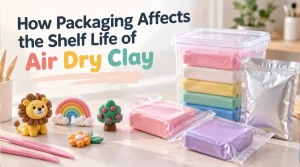
How Packaging Affects the Shelf Life of Air Dry Clay
Learn how packaging affects air dry clay shelf life, moisture retention, product quality, and shipping performance, with practical tips for toy brands.

The combination of these factors makes DIY craft kits highly attractive across both home and educational environments.
A DIY craft kit becomes educational when it requires children to actively think, create, test, and refine ideas.
When assessing whether a craft kit has educational value, consider three questions:
Educational toys should involve creation rather than passive observation.
Examples:
The best educational kits build skills that extend beyond the activity itself.
Common skills include:
Children learn more effectively when they can test ideas and observe outcomes.

For example:
If a craft kit satisfies all three criteria, it typically delivers meaningful educational value.
Sensory play materials have become core components of many DIY craft kits because they naturally combine learning with engagement.
Air dry clay supports:
Children can transform ideas into physical objects without requiring baking equipment, making the activity accessible and safe for home and classroom use.

Playdough is particularly effective for younger children because it helps develop:
Its reusable nature also supports repeated learning experiences.
Kinetic sand encourages:
Because the material flows and holds shape simultaneously, children can experiment with structures and textures more freely than with traditional sand.

Modern educational slime kits often incorporate:
When properly formulated and tested, slime can become a highly engaging introduction to experimentation and material science.

DIY activities require children to:
This process strengthens critical thinking and executive function skills.
Craft-based activities improve:
These skills are foundational for writing and many everyday tasks.
Group crafting activities can help children develop:
Completing a project also creates a sense of achievement that reinforces positive learning behavior.
Whether sourcing for retail, education, or private-label programs, buyers should evaluate DIY craft kits using a structured checklist.

Children’s products should comply with relevant safety standards such as:
Compliance helps ensure materials are appropriate for children’s use in target markets.
Look for:
Poor material quality can negatively impact both learning outcomes and customer satisfaction.
The complexity of the activity should match the developmental stage of the child.
The strongest products encourage multiple uses rather than a single completed activity.
Open-ended materials generally outperform fixed-result craft projects in long-term engagement.
Several trends are likely to shape the next generation of educational craft products.
Manufacturers are increasingly combining creativity with science and engineering concepts.
Examples include:
Parents increasingly favor products that allow children to create their own outcomes rather than follow rigid instructions.
Demand continues to grow for:
Future kits are expected to integrate:
This creates richer learning experiences and broader developmental benefits.

DIY craft kits are rising in popularity because they address a growing demand for educational toys that combine learning, creativity, sensory engagement, and independent play.
The most successful products share three characteristics:
Sensory materials such as air dry clay, playdough, kinetic sand, and slime are particularly well-positioned within this trend because they naturally support hands-on learning while offering strong repeat-play value.
For brands, retailers, and educational distributors, DIY craft kits are no longer simply arts-and-crafts products—they have become an important category within modern educational toys, driven by measurable developmental benefits and sustained consumer demand.
Learn how packaging affects air dry clay shelf life, moisture retention, product quality, and shipping performance, with practical tips for toy brands.
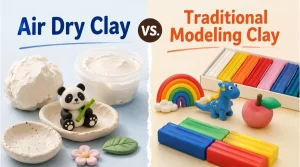
Choosing between air dry clay and modeling clay depends on the activity goal. Explore their features, uses, and selection tips in this complete guide.
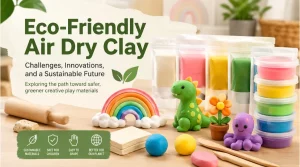
Understand the science behind eco-friendly air dry clay, including material selection, production difficulties, and the future of sustainable toy materials.
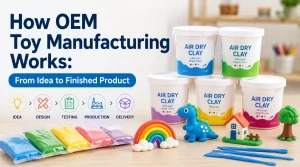
Understand how toy ideas become finished products through OEM manufacturing, with key steps, decision points, and compliance requirements.