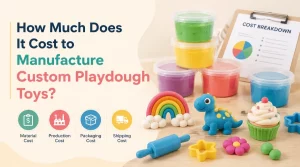
How Much Does It Cost to Manufacture Custom Playdough Toys?
Estimate the cost of custom playdough toys with this B2B guide covering pricing, customization, certifications, and manufacturing decisions.
#1 Toys Manufacturer in China. WhatsApp: +86 139-6690-0919. Email: [email protected]

#1 Toys Manufacturer in China. WhatsApp: +86 139-6690-0919. Email: [email protected]

Choosing the right container is an important part of developing a successful private label playdough product. The container affects product freshness, usability, shelf appeal, shipping cost, production efficiency, and the overall positioning of your brand.
For most private label playdough products, the best container is one that provides an effective seal, is easy for children to open and close, uses the right capacity for the intended play format, and leaves enough printable surface for your branding. The ideal choice depends on your target age group, product quantity, sales channel, target retail price, and desired product positioning.
This guide explains how toy brands, wholesalers, retailers, and startups can evaluate playdough containers before moving into private label production.
A common mistake is choosing a container based primarily on appearance. For playdough, the container should be selected according to the characteristics of the product and how customers are expected to use it.
Before selecting packaging, define these five factors:
These factors determine whether you should prioritize compact packaging, multi-compartment packaging, stackability, durability, or premium presentation.
If the product is designed for frequent reuse, prioritize sealing performance and durability. If it is designed as a low-cost single or small-color set, prioritize packaging efficiency and cost. If it is positioned as a premium gift set, prioritize presentation and customization.
This product-first approach prevents packaging from becoming unnecessarily expensive or unsuitable for the product concept.
A suitable playdough container should meet several basic requirements.
| Factor | Why It Matters | Priority |
|---|---|---|
| Airtightness | Helps reduce drying during storage and repeated use | Very High |
| Material Suitability | Affects durability, safety, and product compatibility | Very High |
| Size | Determines product quantity and shipping efficiency | High |
| Closure | Influences ease of use and resealing | High |
| Stackability | Important for storage, logistics, and retail displays | Medium–High |
| Labeling Area | Determines branding and product information options | High |
| Transparency | Allows customers to see the product | Medium |
| Shape | Influences shelf appearance and packaging efficiency | Medium |
| Cost | Directly affects product margin | Very High |
The best container is therefore not necessarily the cheapest or most attractive option. It is the container that provides the best balance between product protection, usability, logistics, branding, and cost.
Common container materials for playdough include plastic and other packaging materials selected according to the product design.
For children’s playdough, material selection should consider:
For private label products, the container should be evaluated together with the playdough formula rather than treated as an independent packaging component.
Playdough may remain inside the container for extended periods. A container therefore needs to maintain its physical performance without negatively affecting the product during normal storage.
For this reason, container material, lid design, seal structure, and playdough formulation should be tested together before mass production.
For reusable playdough, airtightness is one of the most important packaging considerations.
When playdough is repeatedly exposed to air, its texture can gradually change. Poorly sealed packaging can accelerate this process, particularly when the product is opened and closed frequently.
A good container should therefore:
There is a practical trade-off.
A container with an extremely tight closure may provide good sealing performance but can be difficult for younger children to open. Conversely, a container that is too easy to open may not provide sufficient protection during storage or transportation.
For children’s playdough, the goal is not maximum closure strength. The goal is a reliable seal combined with age-appropriate usability.
For younger target age groups, this balance should be evaluated through actual product testing rather than relying only on packaging specifications.
Container size should correspond to the amount of playdough inside.
Common private label formats include:
Use the following logic:
Small quantity → compact container
Suitable for individual colors, impulse products, party favors, and lower-price products.
Medium quantity → standard reusable tub
Suitable for individual playdough products and general retail products.
Multiple colors → coordinated multi-container set
Suitable for creative activity kits and educational products.
Large quantity → larger container or multi-pack
Suitable for classroom, family, or high-volume applications.
The container should have enough internal capacity to hold the intended amount without excessive empty space.
Excessive headspace can make the product look underfilled while also increasing packaging volume and shipping requirements.
Container shape has a direct impact on logistics.
Round containers are common because they are simple to manufacture and comfortable to handle. However, rectangular or square containers may provide better space utilization during packing and storage.
For B2B products, consider:
If your product will be shipped in large quantities, prioritize packaging efficiency over unusual container shapes.
A visually distinctive container can help a product stand out, but an inefficient shape can increase carton size, storage requirements, and transportation costs.
This is especially important for wholesalers and retailers purchasing by the carton or pallet.
Transparency can be useful for playdough because the product itself provides visual appeal.
Advantages:
Potential limitations:
Advantages:
Potential limitations:
For colorful, straightforward playdough products, transparent containers are often an efficient choice. For highly customized or premium private label concepts, opaque containers may provide greater design flexibility.
The best container for a supermarket product may not be the best option for an online product or educational wholesale pack.
Prioritize:
The package needs to communicate the product concept quickly because customers may compare several similar products on the same shelf.
Prioritize:
Online products face more handling during fulfillment and delivery, so container durability becomes particularly important.
Prioritize:
Prioritize:
The sales channel should therefore be considered before the final container specification is approved.
Private label packaging needs enough space for branding and mandatory product information.
Depending on the market and product configuration, packaging may need to accommodate:
A container with a highly curved surface may look attractive but can make labels difficult to apply cleanly.
Before approving a container, create a full-size label sample and check:
For private label products, packaging dimensions should be confirmed together with the label artwork—not afterward.
The lid is often more important than the container itself.
A well-designed lid should balance:
For multi-color sets, lids can also become part of the product organization system.
For example, color-coded lids can make it easier to identify different playdough colors without opening every container.
For brands developing a large product range, standardized lids can also simplify packaging procurement and production.
Container cost should be evaluated as part of the total product cost.
The packaging cost may include:
A premium container may improve shelf presentation, but it does not automatically create a better product.
Budget product → simple, efficient container
Mid-range product → durable container with customized labeling
Premium product → customized container, decoration, or gift-oriented presentation
For most private label brands, it is more effective to invest in the elements that customers can actually see and use rather than adding packaging complexity without a clear commercial purpose.
Packaging decisions can have a surprisingly large effect on logistics costs.
Consider:
A container that costs slightly more per unit may still be commercially attractive if it allows more units per carton and reduces overall shipping volume.
Conversely, an inexpensive container can become costly if its shape creates significant unused space.
Do not evaluate only:
Container cost per piece
Also evaluate:
Total packaging + logistics cost per sellable unit
This gives a more accurate picture of the commercial impact of the packaging decision.
Because playdough is primarily a children’s product, container usability should be considered alongside safety and durability.
Check whether:
Age grading matters because packaging appropriate for an older child may not be equally appropriate for younger users.
For products intended for the U.S. and European markets, packaging and the finished toy should be evaluated as part of the applicable product safety and compliance process.
A container should not be approved based only on a sample inspection.
For private label playdough, conduct practical testing of the complete package.
Check whether the container maintains an effective closure under normal storage and handling conditions.
Open and close the container multiple times to evaluate whether the lid continues to function properly.
Evaluate whether the container or lid cracks, deforms, or opens unexpectedly during normal transportation conditions.
Observe the interaction between the playdough and packaging over an appropriate storage period.
Check label adhesion, readability, positioning, and barcode performance.
Pack the intended number of units into shipping cartons and evaluate space utilization and protection.
Confirm that the selected container can be consistently filled, closed, labeled, and packed at production scale.
The purpose of testing is not simply to verify the container. It is to verify the complete product-packaging system.
A visually attractive container may have poor sealing performance or inefficient shipping dimensions.
Better approach: Evaluate appearance together with functionality and logistics.
Excessive empty space can make the product appear underfilled and increase packaging volume.
Better approach: Match container capacity to the actual product quantity.
The container may look good while the lid performs poorly.
Better approach: Test the complete container-and-lid system.
A curved or irregular container may limit printable space.
Better approach: Test the actual label artwork on a physical packaging sample.
A low-cost container may increase carton size and shipping costs.
Better approach: Calculate the total landed packaging impact.
A container that works for a small sample may create problems during filling, closing, labeling, or packing at scale.
Better approach: Conduct a production trial before confirming the final packaging specification.
For brands that are comparing several container options, use this six-step process:
Determine:
Determine whether the product will be sold through:
Compare options based on:
Compare:
Evaluate sealing, durability, usability, labeling, storage, and transportation.
Before mass production, confirm:
This framework helps turn packaging selection from a visual decision into a measurable product-development decision.
The best container for private label playdough is not simply the one that looks attractive or costs the least. It should provide reliable sealing, appropriate capacity, child-friendly usability, efficient shipping, sufficient branding space, and commercially viable production costs.
For most B2B playdough products, the selection process should follow this order:
Product requirements → Target market → Sales channel → Container design → Cost analysis → Physical testing → Production validation.
Making the container decision early and testing it together with the playdough formula can reduce packaging problems, improve product consistency, and create a more commercially practical private label product.
For brands, wholesalers, and startups developing customized playdough, working with an experienced OEM/ODM manufacturer can also simplify the process by evaluating the playdough formula, container, labeling, packaging configuration, and production requirements as one complete product system.
Our manufacturing capabilities cover children’s sensory products including playdough, air dry clay, kinetic sand, and slime, with product development and private label support for international markets. Products are developed with applicable requirements such as ASTM F963, EN71, and CPSIA in mind.
For most reusable playdough products, a durable container with a reliable resealable closure is a practical choice. The final selection should depend on product quantity, target age, sales channel, packaging budget, and branding requirements.
Yes. A reliable seal is important for reusable playdough because repeated exposure to air can affect product texture over time. However, sealing performance should be balanced with age-appropriate ease of opening.
The container should match the net quantity of playdough without excessive unused space. Small containers work well for individual colors, while larger containers or multi-packs are suitable for activity sets, classroom products, or family-oriented products.
Not necessarily. Transparent containers are useful when product color is an important selling point. Opaque containers can provide greater control over the visual design and brand identity. The right choice depends on your product positioning.
Start by optimizing container size, shape, material, decoration, and carton utilization. Compare total packaging and logistics costs rather than looking only at the container price per unit.
Depending on the packaging option and production volume, private label customization may include container color, lid color, labels, printing, decoration, and packaging configuration. The available options depend on the selected container and production requirements.
At minimum, evaluate closure performance, repeated opening and closing, container durability, product-packaging compatibility, label application, storage performance, transportation protection, and production-line feasibility.
More Related...
Estimate the cost of custom playdough toys with this B2B guide covering pricing, customization, certifications, and manufacturing decisions.
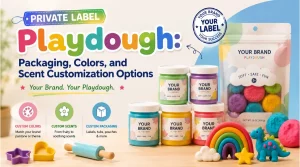
A practical guide to private label playdough customization, covering packaging choices, color development, scent options, and safety considerations.
A burger comes out 🍔 #akia #fun #kidstoys #diy #clay #shorts
The pig starts sneezing clay 🤣🐷 #fun #diy #kidstoys #clay #akia

Our team will answer your inquiries within 48 hours.
Copyright © 2026 GuangDong AKIA Technology Co,. Ltd. All Rights Reserved