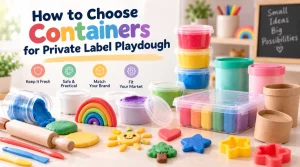
How to Choose Containers for Private Label Playdough
Choosing playdough packaging? Explore key factors for private label containers, including airtightness, size, materials, branding, logistics, and cost.

Prices are reference ranges only. Actual costs vary according to specifications and order volume.
Instead of asking “How much does custom playdough cost?”, buyers should ask:
Which components are driving the cost?
Most manufacturing costs come from six major factors.

The dough itself is only one part of the overall cost.
Pricing depends on factors such as:
For educational products sold in North America and Europe, manufacturers generally formulate playdough to comply with:
Compliance materials may increase production cost slightly but greatly reduce regulatory risks.
Packaging is often one of the largest cost variables.
Examples include:
A premium package can sometimes cost more than the playdough itself.
Decision Guide
Choose simple packaging if:
Choose premium packaging if:
Many custom playdough toys include additional components:
Every additional accessory increases:
A larger accessory count does not always create more customer value.
Many successful educational kits focus on well-designed learning tools instead of quantity.

If your product requires completely unique accessories, new injection molds are usually necessary.
Typical tooling investment depends on:
For brands planning long-term product lines, custom tooling often delivers better product differentiation than relying on existing molds.
Order quantity has a direct impact on unit cost.
This happens because fixed costs—such as setup, printing plates, and machine preparation—are distributed across more units.
For startups, it is often better to optimize product configuration rather than simply increasing order quantity.
Products entering North America and Europe should be designed for compliance from the beginning.
Typical requirements include:
Testing represents only a small percentage of total project cost, but failing compliance can lead to shipment delays, recalls, or rejected products.
Building compliance into product development is generally more cost-effective than redesigning products after testing.

Many first-time buyers focus only on unit price.
However, the total project cost usually includes:
A supplier offering the lowest manufacturing price may not provide the lowest total project cost.
Instead of reducing material quality, experienced buyers typically optimize product design.
Effective approaches include:
Using existing containers or accessories reduces tooling costs.
Removing unnecessary inserts or oversized boxes lowers both production and shipping expenses.
Fewer colors and standardized accessories improve manufacturing efficiency.

Producing multiple product variants together often reduces setup costs.
Products designed around efficient production processes generally have lower long-term costs than products requiring extensive manual assembly.
Before requesting a quotation, prepare the following information:
Providing complete specifications allows manufacturers to recommend cost-saving alternatives rather than quoting only the requested design.

Custom playdough manufacturing costs are determined by product design rather than by the dough alone. Formula, packaging, accessories, tooling, production volume, and compliance requirements all contribute to the final price.
For most toy brands, wholesalers, and educational product companies, the best purchasing strategy is to evaluate the total project cost instead of comparing unit prices alone. A product designed for efficient manufacturing, appropriate packaging, and regulatory compliance is often more cost-effective over its entire lifecycle than one built solely around the lowest initial quotation.
Choosing playdough packaging? Explore key factors for private label containers, including airtightness, size, materials, branding, logistics, and cost.
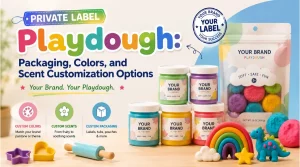
A practical guide to private label playdough customization, covering packaging choices, color development, scent options, and safety considerations.
A burger comes out 🍔 #akia #fun #kidstoys #diy #clay #shorts
The pig starts sneezing clay 🤣🐷 #fun #diy #kidstoys #clay #akia