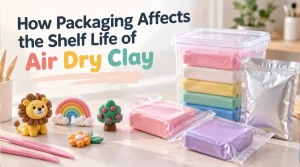
How Packaging Affects the Shelf Life of Air Dry Clay
Learn how packaging affects air dry clay shelf life, moisture retention, product quality, and shipping performance, with practical tips for toy brands.
#1 Toys Manufacturer in China. WhatsApp: +86 139-6690-0919. Email: [email protected]

#1 Toys Manufacturer in China. WhatsApp: +86 139-6690-0919. Email: [email protected]

OEM toy manufacturing is the process in which a factory produces toys based on a brand owner’s concept, specifications, or product requirements. The typical OEM workflow includes:
For educational and sensory toys such as air dry clay, playdough, kinetic sand, and slime, successful OEM manufacturing depends on three factors:
The earlier these factors are addressed, the lower the development risk and overall project cost.
OEM (Original Equipment Manufacturing) refers to a production model where a manufacturer produces products according to a customer’s design, specifications, branding, and packaging requirements.
In the toy industry, OEM manufacturing is commonly used by:
The factory handles manufacturing and quality control, while the customer owns the brand and market strategy.
| Factor | OEM | ODM |
|---|---|---|
| Product Concept | Customer | Manufacturer |
| Formula/Design Control | High | Limited |
| Customization Level | High | Medium |
| Development Time | Longer | Shorter |
| Brand Differentiation | Stronger | Lower |
Decision rule:
Every successful OEM project starts with a clear product brief.
Typical requirements include:
For example:
| Requirement | Example |
|---|---|
| Product | Air Dry Clay |
| Age Group | 3+ |
| Market | USA |
| Colors | 12 Colors |
| Package | Plastic Cups |
| Standard | ASTM F963, CPSIA |
| Retail Price Target | $9.99 |
Many development delays occur because product requirements change after sampling begins.
Decision rule:
If the target retail price is fixed, define the cost target before sample development. This reduces redesign work later.
For sensory toys, material performance directly affects user experience.
Manufacturers typically develop or adjust formulas based on:
Examples:
| Product | Key Performance Factors |
|---|---|
| Air Dry Clay | Smooth texture, crack resistance |
| Playdough | Softness, color consistency |
| Kinetic Sand | Flowability, mold retention |
| Slime | Stretchability, transparency |
Some buyers focus only on appearance.
However, consumer satisfaction is usually driven by how the product performs during play.
Decision rule:
For sensory toys, prioritize performance testing before finalizing packaging or color selections.
Once the formula and specifications are confirmed, prototype samples are produced.
A sample review typically evaluates:
At this stage, multiple revisions are common.
Before approving samples, verify:
✓ Product texture meets expectations
✓ Colors match approved references
✓ Packaging dimensions are correct
✓ Label information is accurate
✓ Safety warnings are included
✓ Product cost remains within target
Decision rule:
Do not approve production samples until all critical performance characteristics are validated.
For children’s products, compliance is not optional.
Different markets require different regulations.
Common requirements include:
| Market | Typical Standards |
|---|---|
| United States | ASTM F963, CPSIA |
| European Union | EN71 |
| United Kingdom | UKCA-related requirements |
| Australia | Applicable toy safety regulations |
Educational and sensory toy manufacturers should ensure that products comply with the standards required by the destination market.
For many OEM projects involving air dry clay, playdough, kinetic sand, and slime, compliance testing may include:
Testing failures discovered after packaging production can result in:
Decision rule:
Confirm regulatory requirements before finalizing formulas and artwork.
Packaging affects both consumer perception and logistics costs.
Common packaging options include:
Packaging development typically includes:
| Priority | Recommended Packaging |
|---|---|
| Lowest Cost | Plastic Cups |
| Retail Display | Color Boxes |
| Premium Positioning | Gift Sets |
| Educational Use | Activity Kits |
Decision rule:
Choose packaging based on sales channel requirements rather than appearance alone.
After sample approval and compliance verification, mass production begins.
Typical production stages include:
Production planning should consider:
Potential risks include:
| Risk | Impact |
|---|---|
| Raw Material Delays | Production Schedule |
| Packaging Delays | Shipment Date |
| Formula Variations | Product Consistency |
| Forecast Errors | Inventory Issues |
Decision rule:
Place packaging orders as early as possible because packaging components often become the production bottleneck.
Quality control should occur throughout the manufacturing process, not only at the final inspection stage.
A comprehensive quality control system generally includes:
Checks:
Checks:
Checks:
For sensory toys, consistency is often more important than individual sample performance.
Decision rule:
Evaluate production batch consistency, not just single-unit quality.
After inspection approval, products are prepared for shipment.
Typical shipping methods include:
| Method | Best For |
|---|---|
| Sea Freight | Large Orders |
| Air Freight | Urgent Orders |
| Express Courier | Express Courier |
| Question | Why It Matters |
|---|---|
| Can they customize formulas? | Product differentiation |
| Do they understand target-market regulations? | Compliance risk reduction |
| Can they provide consistent quality at scale? | Brand protection |
| Can they support packaging customization? | Retail readiness |
| Do they have documented QC procedures? | Quality assurance |
Decision rule:
A manufacturer that can consistently meet safety, quality, and delivery requirements is usually a better long-term partner than one offering the lowest initial quotation.
OEM toy manufacturing is a structured process that transforms a product idea into a market-ready toy through development, testing, compliance verification, production, and quality control.
For educational sensory products such as air dry clay, playdough, kinetic sand, and slime, project success depends on three priorities:
Brands that follow this process can reduce development risk, shorten time to market, and build products that meet both regulatory requirements and consumer expectations.
More Related...
Learn how packaging affects air dry clay shelf life, moisture retention, product quality, and shipping performance, with practical tips for toy brands.
Choosing between air dry clay and modeling clay depends on the activity goal. Explore their features, uses, and selection tips in this complete guide.
Understand the science behind eco-friendly air dry clay, including material selection, production difficulties, and the future of sustainable toy materials.
Find out why parents and educators prefer DIY craft kits that encourage hands-on learning, independent creativity, and skill development.

Our team will answer your inquiries within 48 hours.
Copyright © 2026 GuangDong AKIA Technology Co,. Ltd. All Rights Reserved